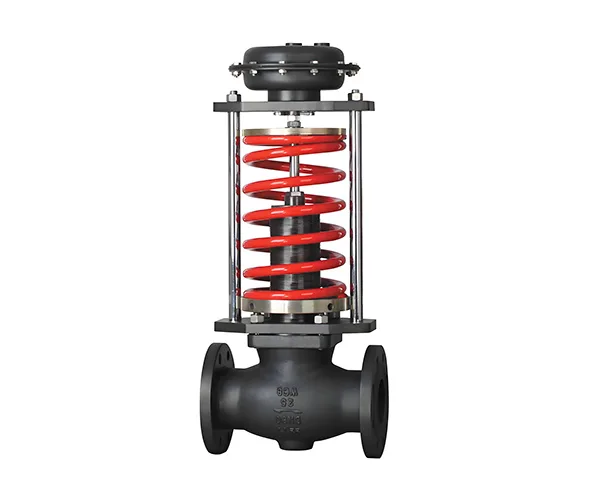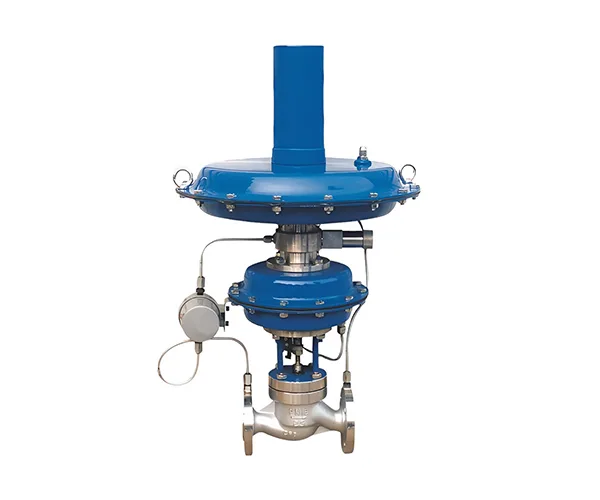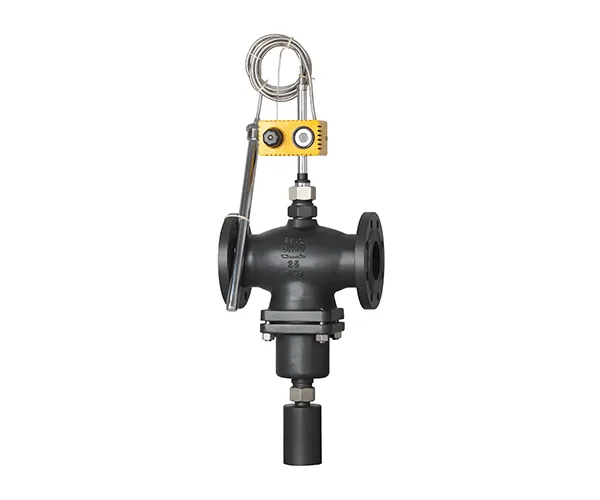
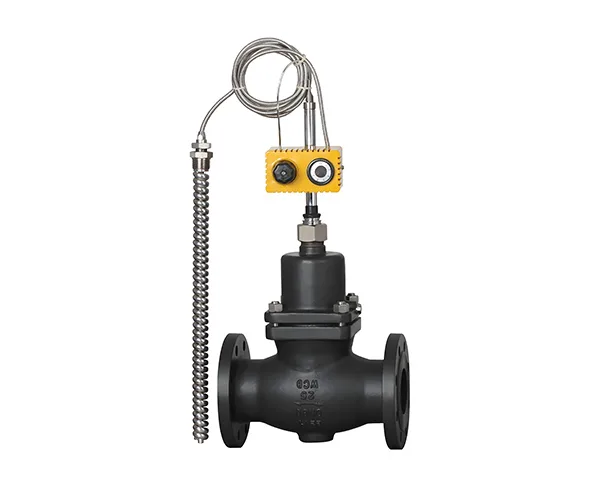
Self-operated temperature regulating valve
The Self‑operated Temperature Regulating Valve is an automatic control valve that requires no external power source (electricity or compressed air). It opens and closes solely by the temperature change of the controlled medium. Its core component is a temperature sensor bulb (thermostatic bulb) and an actuating bellows.
Category:Self-operated control valve
Call Us Anytime
15669818867
Product
Contact us
- No.20 Xueyuan Road, Haidian District, Beijing
- 15669818867
- Mr JIANG
- 812921123@qq.com
Product Overview
The Self‑operated Temperature Regulating Valve is an automatic control valve that requires no external power source (electricity or compressed air). It opens and closes solely by the temperature change of the controlled medium. Its core component is a temperature sensor bulb (thermostatic bulb) and an actuating bellows. When the temperature sensing medium (liquid, gas, or wax) inside the bulb expands by heating or contracts by cooling, a pressure change is generated and transmitted through a capillary tube to the actuator, which moves the valve stem and regulates the flow rate, thereby achieving constant temperature control.
With simple construction, high reliability, and no need for external energy, this valve is particularly suitable for steam heating, hot water heating, heat exchanger temperature control, and HVAC applications. The valve is available with flanged or threaded connections, in materials such as cast iron, carbon steel, and stainless steel. Nominal diameters range from DN15 to DN300, and the temperature range is –20°C to +250°C.
Product Structure
The Self‑operated Temperature Regulating Valve mainly consists of the following parts:
-
Body: Cast or forged body in gray cast iron, ductile iron, carbon steel (WCB), stainless steel (CF8/CF8M), etc. Connections are flanged or threaded, conforming to GB/T 9113, ANSI B16.5, EN 1092‑1, etc. The internal flow path is straight‑through or angle pattern.
-
Valve Plug / Disc: Plunger‑type, single‑seated, or double‑seated plug. The sealing face can be hardfaced with Stellite or covered with PTFE/PEEK. The plug cooperates with the seat to regulate flow.
-
Seat: Metal seat machined in the body or inserted soft seat.
-
Temperature Sensor Bulb (Thermostatic Bulb): Filled with a sensing medium (acetone, alcohol, Freon, wax, etc.). It is installed in the controlled medium pipeline or equipment to sense temperature changes.
-
Capillary Tube: Connects the sensor bulb to the actuator, transmitting the pressure signal.
-
Actuator (Bellows/Capsule): Receives the pressure from the sensor bulb and moves the valve stem up or down to adjust the plug opening.
-
Set Point Adjustment Spring: Balances the pressure from the sensor bulb to set the target temperature.
-
Set Point Knob / Handwheel: Allows manual setting of the desired control temperature.
-
Valve Stem and Sealing: Stainless steel stem with PTFE or graphite packing.
Compact construction, self‑operating, requiring no external energy.
Function
-
Automatic Constant Temperature Control: According to temperature changes of the controlled medium, the valve automatically adjusts its opening to maintain the set temperature. For heating type: temperature rise closes the valve; for cooling type: temperature rise opens the valve.
-
No External Energy Required: Driven solely by pressure changes from thermal expansion/contraction of the sensing medium. No electricity or compressed air needed – ideal for locations without utilities or with explosion‑proof requirements.
-
Proportional Control: Continuously adjusts the valve plug opening for smooth temperature control without on‑off shock.
-
Adjustable Temperature Set Point: By changing the spring preload, the target temperature can be set within a certain range.
-
Safe and Reliable: No electrical components, no spark risk – suitable for flammable/explosive environments.
-
Fail‑Safe Feature (optional): Depending on spring configuration, the valve can fail open or fail closed if the sensor bulb fails.
-
Wide Temperature Range: Different sensing media cover temperature ranges from –20°C to +250°C.
Working Conditions
-
Applicable Media: Steam, hot water, thermal oil, cooling water, superheated steam (high‑temperature version), etc.
-
Temperature Range: –20°C to +250°C (standard); high‑temperature version up to +350°C.
-
Pressure Rating: PN16, PN25, PN40 (Class 150, Class 300).
-
Nominal Diameter: DN15 – DN300 (1/2″ – 12″).
-
Installation: The sensor bulb is inserted into a thermowell on the pipeline or equipment; the valve body is installed in the piping.
-
Typical Applications:
-
Outlet temperature control of steam‑heated heat exchangers
-
Return water temperature regulation in hot water heating systems
-
Temperature control in cooling water recirculation systems
-
Oil preheating temperature stabilization
-
Jacket steam temperature regulation for chemical reactors
-
Constant temperature supply of domestic hot water
-
Freeze protection in HVAC systems
-
Summary
The Self‑operated Temperature Regulating Valve, with its advantages of no external energy required, simple and reliable construction, proportional control, and explosion‑proof safety, is an economical and practical solution for temperature control in heating, heat exchange, HVAC, and industrial processes. It is especially suitable for applications where no electricity or compressed air is available, where explosion protection is required, or where installation space is limited – such as steam heating systems, hot water circulation, and oil preheating.
Compared with electric or pneumatic control valves, the self‑operated temperature regulating valve requires no cables or air lines, has a lower failure rate, and demands minimal maintenance. The user simply sets the desired temperature, and the valve automatically maintains it without manual intervention. For temperature control applications that demand simplicity, reliability, and low cost, the Self‑operated Temperature Regulating Valve is an indispensable automation component.
| Nominal Diameter (DN) | DN15 – DN300 (1/2″ – 12″) |
| Nominal Pressure (PN) | PN16, PN25, PN40 (Class 150, Class 300) |
| Applicable Temperature | –20°C to +250°C (standard); up to +350°C (high temp) |
| Body Material | Gray cast iron, ductile iron, carbon steel (WCB), stainless steel (CF8/CF8M) |
| Plug / Seat Material | Stainless steel + optional Stellite hardfacing / PTFE/PEEK overlay |
| Sensor Bulb Fill Medium | Liquid (acetone/alcohol), gas (Freon), wax (paraffin) |
| Sensor Bulb Material | Stainless steel (304/316) or brass |
| Capillary Tube Length | Standard 3m / 5m / 8m (custom lengths available) |
| Actuator Type | Bellows type or diaphragm capsule type |
| Temperature Setting Range | 0–60°C, 30–90°C, 50–120°C, 100–200°C, 150–250°C, etc. |
| Control Accuracy | ±1°C to ±5°C (depending on operating conditions) |
| Connection Type | Flanged (GB/T 9113, ANSI B16.5) or threaded (NPT, BSP) |
| Flow Characteristic | Linear or equal percentage |
| Leakage Class | Soft seal: ANSI Class VI; Metal seal: ANSI Class IV |