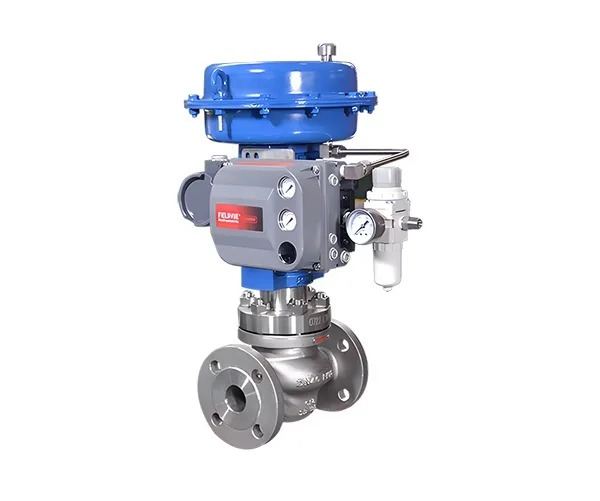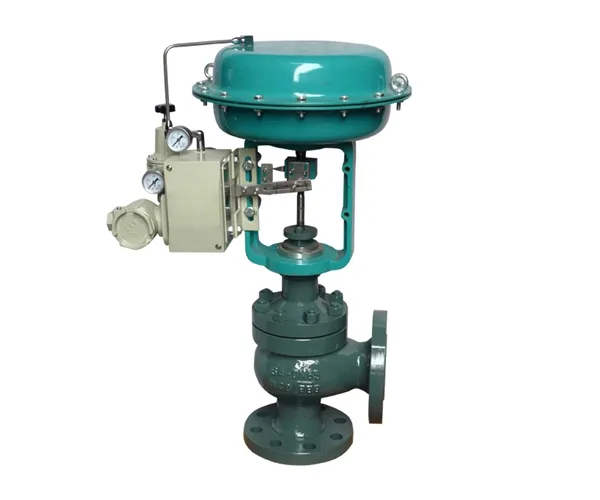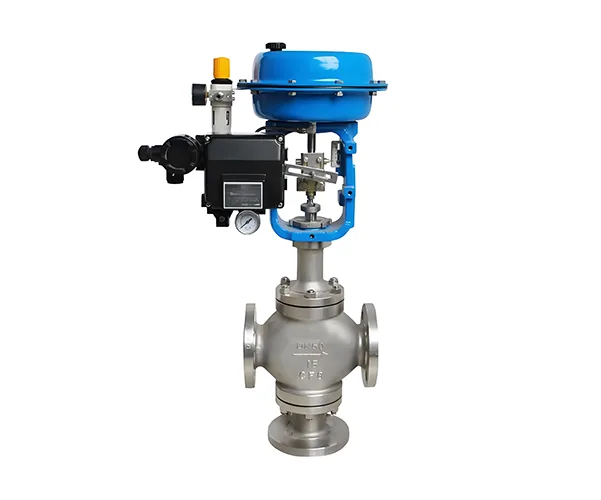
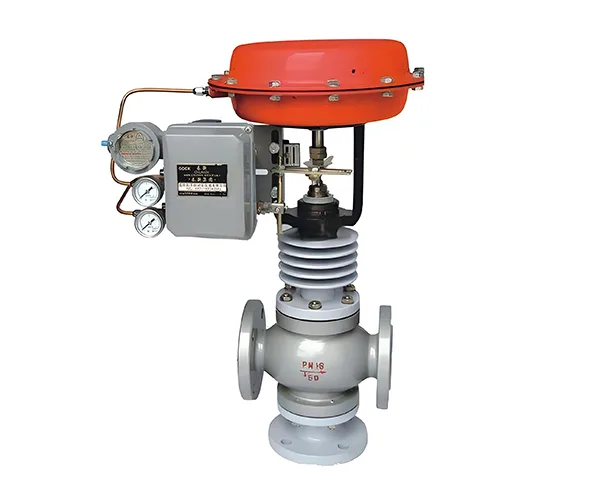
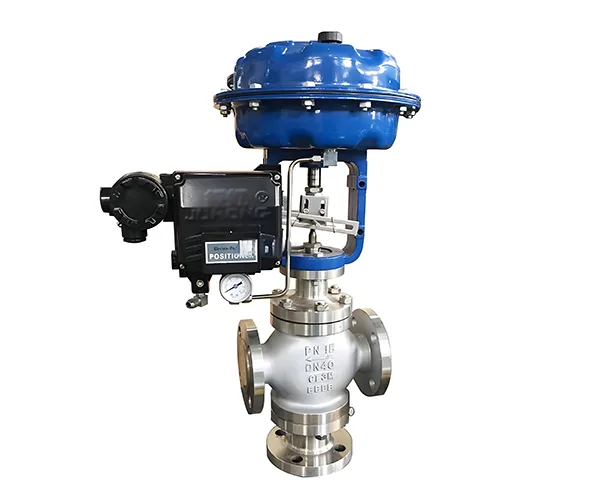
Pneumatic three-way control valve
The Pneumatic Three‑Way Control Valve is a pneumatic control valve with three ports (one inlet/two outlets or two inlets/one outlet), designed for mixing (combining two inlet flows into one outlet) or diverting (splitting one inlet flow into two outlets) applications. Driven by a pneumatic diaphragm actuator, it receives a standard pneumatic signal (0.02–0.1 MPa) or a 4–20 mA electrical signal via an I/P converter, and changes the plug position to proportionally distribute flow among the ports.
Category:Pneumatic control valve
Tags:
Call Us Anytime
15669818867
Product
Contact us
- No.20 Xueyuan Road, Haidian District, Beijing
- 15669818867
- Mr JIANG
- 812921123@qq.com
Product Overview
The Pneumatic Three‑Way Control Valve is a pneumatic control valve with three ports (one inlet/two outlets or two inlets/one outlet), designed for mixing (combining two inlet flows into one outlet) or diverting (splitting one inlet flow into two outlets) applications. Driven by a pneumatic diaphragm actuator, it receives a standard pneumatic signal (0.02–0.1 MPa) or a 4–20 mA electrical signal via an I/P converter, and changes the plug position to proportionally distribute flow among the ports.
A single three‑way valve can replace two single‑seat control valves plus a tee fitting, offering compact construction, simplified installation, and lower cost. This valve is widely used in petrochemical, chemical, power generation, metallurgy, HVAC, heat exchanger temperature control, and ratio control applications. Available in nominal diameters from DN15 to DN300, pressure ratings from PN16 to PN63 (Class 150–300), with body materials such as carbon steel and stainless steel. Connection type is flanged.
Product Structure
The Pneumatic Three‑Way Control Valve mainly consists of the pneumatic actuator and the three‑way valve body assembly.
Pneumatic Actuator:
-
Diaphragm Case: Upper and lower casings made of carbon steel or cast iron.
-
Rubber Diaphragm: Oil‑resistant fabric‑reinforced rubber diaphragm dividing the actuator into two chambers.
-
Spring: Multiple stainless steel or spring steel springs providing plug return force.
-
Stem (Actuator Stem): Stainless steel stem connecting the diaphragm to the valve stem, transmitting thrust.
-
Air Connection: Port for connecting the air supply line to receive the control signal.
Three‑Way Valve Body Assembly:
-
Body: Cast or forged three‑way body in carbon steel (WCB), stainless steel (CF8/CF8M), etc. The flow path is T‑pattern or L‑pattern, with three ports – inlet, outlet A, outlet B (diverting type) or inlet A, inlet B, outlet (mixing type). Connection type is flanged, conforming to GB/T 9113, ANSI B16.5, EN 1092‑1, etc.
-
Plug: Special three‑way plug, typically double‑seated or single‑seated balanced type. The sealing face can be hardfaced with Stellite or covered with PTFE/PEEK. The plug position determines the flow area ratio among the ports.
-
Seats: Two or three seats forming sealing pairs with the plug.
-
Valve Stem: Stainless steel stem, connected to the actuator stem at the top and the plug at the bottom.
-
Packing Box: Contains PTFE or flexible graphite packing to prevent external leakage.
-
Bonnet: Connected to the body, housing the packing and stem; available in standard or extension (for high temperature) types.
Compact construction; a single valve completes mixing or diverting control without external piping.
Function
-
Mixing Function: Two inlets, one outlet. As the plug moves, the flow ratio from the two inlets changes; the total flow is the sum of both inlets. Suitable for proportional mixing of two fluids.
-
Diverting Function: One inlet, two outlets. As the plug moves, the inlet flow is proportionally distributed to the two outlets. Suitable for splitting one fluid stream to two users.
-
Temperature Control: In heat exchangers or HVAC systems, mixing or diverting adjusts the ratio of hot and cold media, achieving precise outlet temperature control.
-
Proportional Regulation: Continuously and linearly adjusts the flow ratio among ports with no on‑off shock, providing smooth control.
-
Good Shut‑Off Performance: Double‑seated three‑way valves have slightly higher leakage (ANSI Class III–IV); single‑seated balanced types can achieve Class IV–V.
-
Fail‑Safe Action: Depending on air‑to‑open/air‑to‑close configuration, the plug moves to a preset safe position on loss of air supply.
-
Economical Alternative: One three‑way valve replaces two single‑seat valves plus a tee fitting, reducing installation space and cost.
Working Conditions
-
Applicable Media: Water, hot water, thermal oil, steam, refrigerant, chemical liquids, gas, etc.
-
Temperature Range: –29°C to +200°C (standard PTFE packing); –29°C to +400°C (graphite packing).
-
Pressure Rating: PN16, PN25, PN40, PN63 (Class 150, 300).
-
Nominal Diameter: DN15 – DN300 (1/2″ – 12″).
-
Air Supply Pressure: 0.14 MPa – 0.6 MPa (standard 0.4 MPa).
-
Signal Range: Standard pneumatic signal 0.02–0.1 MPa; can be equipped with I/P converter for 4–20 mA.
-
Typical Applications:
-
Heat exchanger bypass temperature control (mixing or diverting)
-
Chilled/hot water system conversion from two‑way to three‑way regulation in HVAC
-
Hot/cold media ratio control for chemical reactors
-
Boiler feedwater recirculation systems
-
Lubricating oil cooler temperature control
-
Proportional mixing of two liquids
-
Gas distribution network diverting regulation
-
Summary
The Pneumatic Three‑Way Control Valve, with its advantages of integrated three‑way body, mixing/diverting dual functionality, precise proportional regulation, and cost savings by replacing two single‑seat valves, is an ideal choice for fluid distribution and temperature control systems. This valve features flanged connections, providing robust and reliable installation for medium‑ to high‑pressure pipelines.
It is particularly suitable for heat exchanger bypass regulation, hot/cold water mixing in HVAC systems, and heating medium ratio control for chemical reactors, greatly simplifying piping design and reducing installation and maintenance costs. Compared with traditional solutions using two single‑seat valves plus a tee fitting, the three‑way control valve offers more compact construction, better synchronized control, and lower investment. For automated systems requiring proportional mixing or diverting of fluids, the Pneumatic Three‑Way Control Valve is an efficient and reliable solution.
| Nominal Diameter (DN) | DN15 – DN300 (1/2″ – 12″) |
| Nominal Pressure (PN) | PN16, PN25, PN40, PN63 (Class 150, 300) |
| Applicable Temperature | –29°C to +400°C (depending on packing & bonnet type) |
| Body Material | Carbon steel (WCB), stainless steel (CF8/CF8M/CF3M) |
| Plug Material | Stainless steel (304/316/17‑4PH) + optional Stellite hardfacing / PTFE overlay |
| Seat Material | Matching plug material, optional Stellite hardfacing / PTFE overlay |
| Packing Material | PTFE, flexible graphite |
| Actuator Type | Pneumatic multi‑spring diaphragm actuator |
| Action Mode | Air‑to‑open or air‑to‑close (depending on plug configuration) |
| Flow Characteristic | Linear or equal percentage |
| Leakage Class | Double‑seated: ANSI Class III–IV; Single‑seated balanced: Class IV–V |
| Rangeability | 30:1 |
| Connection Type | Flanged (GB/T 9113, ANSI B16.5, EN 1092‑1) |
| Accessories | Valve positioner, solenoid valve, limit switches, air filter regulator, etc. |