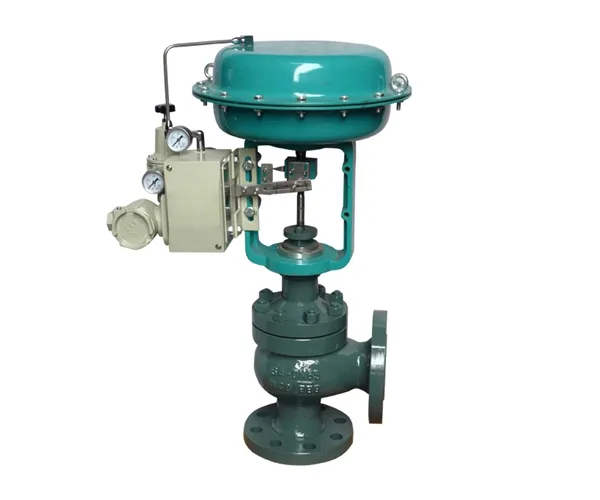
Pneumatic Angle Control Valve
The Pneumatic Angle Control Valve is a high-performance flow control solution designed for precise regulation of fluids in high-pressure drop and erosive applications. Featuring a compact angle body design and a diaphragm-style pneumatic actuator, it ensures reliable operation in demanding environments such as steam systems, power plants, and chemical processing units. Its unique geometry minimizes turbulence and erosion, making it ideal for applications with high ΔP and particulate-laden media.
Category:Pneumatic control valve
Tags:
Call Us Anytime
15669818867
Product
Contact us
- No.20 Xueyuan Road, Haidian District, Beijing
- 15669818867
- Mr JIANG
- 812921123@qq.com
Product Overview
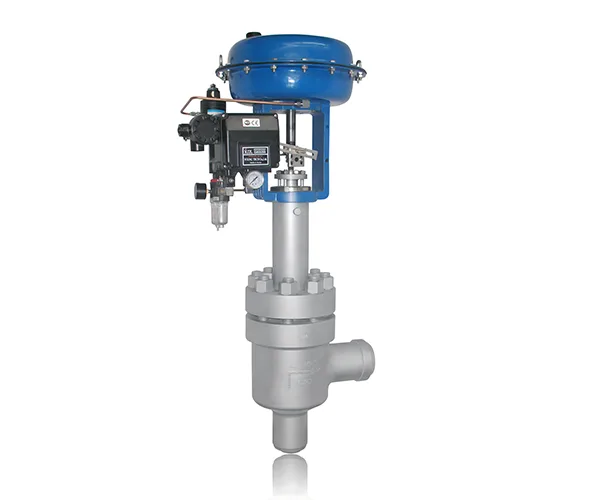
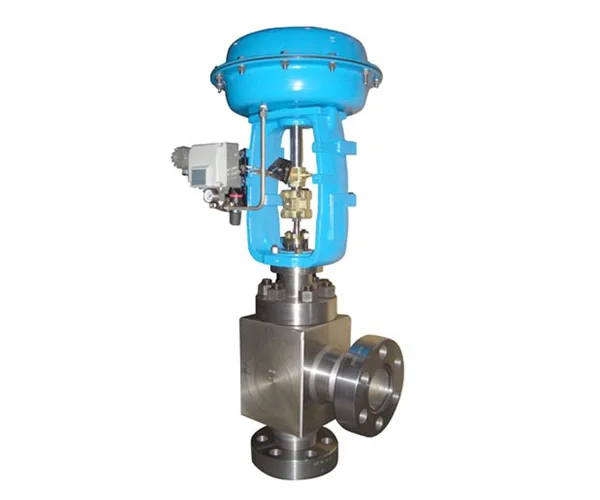
The Pneumatic Angle Control Valve is a pneumatic control valve with a body flow path that turns 90° (inlet and outlet axes are perpendicular). It is driven by a pneumatic diaphragm actuator. Compared with straight‑through control valves, the angle valve offers a simpler flow path, lower pressure loss, strong resistance to cavitation and flashing, and is less prone to clogging. It is particularly suitable for high differential pressure applications, media containing suspended particles, crystallizing fluids, or high‑viscosity fluids.
The valve receives a standard pneumatic signal (0.02–0.1 MPa) or a 4–20 mA electrical signal via an I/P converter, and changes the flow area between the plug and seat to precisely regulate flow, pressure, and other parameters. Widely used in petrochemical, chemical, power generation, metallurgy, food, and pharmaceutical industries, the valve is available in nominal diameters from DN15 to DN200, pressure ratings from PN16 to PN160 (Class 150–900), with body materials such as carbon steel and stainless steel. Connection type is flanged.
Product Structure
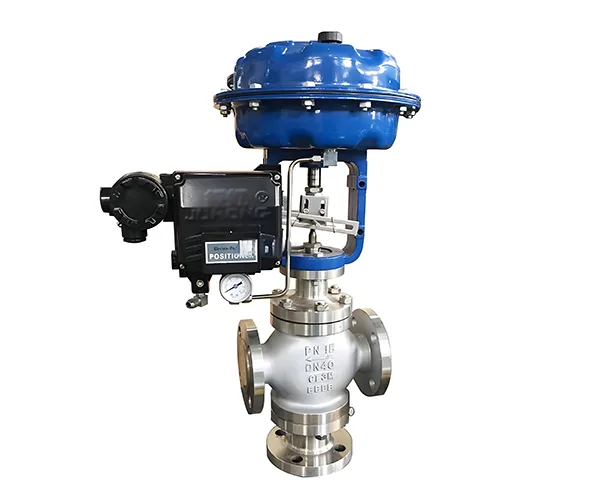
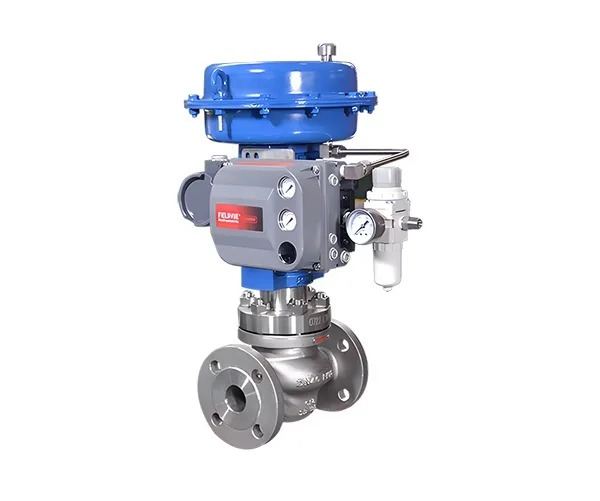
The Pneumatic Angle Control Valve mainly consists of the pneumatic actuator and the angle valve body assembly.
Pneumatic Actuator:
-
Diaphragm Case: Upper and lower casings made of carbon steel or cast iron.
-
Rubber Diaphragm: Oil‑resistant fabric‑reinforced rubber diaphragm dividing the actuator into two chambers.
-
Spring: Multiple stainless steel or spring steel springs providing plug return force.
-
Stem (Actuator Stem): Stainless steel stem connecting the diaphragm to the valve stem, transmitting thrust.
-
Air Connection: Port for connecting the air supply line to receive the control signal.
Angle Valve Body Assembly:
-
Body: Cast or forged angle body in carbon steel (WCB), stainless steel (CF8/CF8M), etc. The flow path is a 90° angle, with inlet and outlet axes perpendicular. Connection type is flanged, conforming to GB/T 9113, ANSI B16.5, EN 1092‑1, etc.
-
Plug: Single‑seat plunger‑type, cage‑guided, or bellows seal plug. The sealing face can be hardfaced with Stellite or covered with PTFE/PEEK. The plug profile determines the flow characteristic (linear, equal percentage, quick opening).
-
Seat: Removable seat forming the sealing pair with the plug, made of matching material.
-
Valve Stem: Stainless steel stem, connected to the actuator stem at the top and the plug at the bottom.
-
Packing Box: Contains PTFE or flexible graphite packing to prevent external leakage. For high‑temperature or corrosive services, a bellows seal is optional.
-
Bonnet: Connected to the body, housing the packing and stem; available in standard, extension (for high temperature), or bellows seal types.
-
Cage (Guide Bushing): Optional cage for guiding the plug, reducing noise, and anti‑cavitation.
Compact construction; the angle flow path redirects the medium, effectively reducing direct erosion of the sealing surfaces by high‑velocity media.
Function
-
Flow Regulation: By varying the plug stroke, the flow area is continuously changed, enabling precise flow control.
-
Anti‑Cavitation & Anti‑Flashing: The angle flow path directs high‑velocity media toward the bottom of the body, reducing erosion of the sealing surfaces and extending service life – especially suitable for high‑differential‑pressure liquid applications.
-
Anti‑Clogging Performance: The 90° flow path has no dead spots and does not accumulate solid particles, making it suitable for media containing suspended solids, crystallizing fluids, or high‑viscosity media.
-
Self‑Draining Capability: The bottom of the angle body can serve as a drain port, facilitating cleaning and residual liquid removal – ideal for sanitary applications in food and pharmaceutical industries.
-
High Shut‑Off Performance: The single‑seat design provides low leakage. Soft sealing achieves ANSI Class VI (bubble‑tight), and metal sealing achieves Class IV.
-
Fail‑Safe Action: Depending on air‑to‑open/air‑to‑close configuration, the valve automatically goes to fully open or fully closed position on loss of air supply.
-
Accessory Options: Can be equipped with a valve positioner, solenoid valve, limit switches, air filter regulator, etc.
Working Conditions
-
Applicable Media: Water, steam, oil, chemical liquids, fluids containing particles, high‑viscosity media, crystallizing media, corrosive liquids, etc.
-
Temperature Range: –29°C to +200°C (standard PTFE packing); –29°C to +400°C (graphite packing); –196°C to +450°C (bellows seal + extension bonnet).
-
Pressure Rating: PN16, PN25, PN40, PN63, PN100, PN160 (Class 150, 300, 600, 900).
-
Nominal Diameter: DN15 – DN200 (1/2″ – 8″).
-
Air Supply Pressure: 0.14 MPa – 0.6 MPa (standard 0.4 MPa).
-
Signal Range: Standard pneumatic signal 0.02–0.1 MPa; can be equipped with an I/P converter for 4–20 mA.
-
Typical Applications:
-
High‑differential‑pressure liquid pressure reduction (anti‑cavitation)
-
Slurry or wastewater flow control containing solid particles
-
Process control for crystallizing media (e.g., urea, polymers)
-
Flow regulation of high‑viscosity fluids (e.g., heavy oil, syrup)
-
Bottom discharge and flow control of reactors
-
Steam ejector outlet pressure regulation
-
CIP cleaning lines in food and pharmaceutical industries
-
Summary
The Pneumatic Angle Control Valve, with its unique advantages of 90° angle flow path, strong anti‑cavitation/anti‑flashing capability, anti‑clogging performance, and self‑draining design, is an ideal choice for high‑differential‑pressure, dirty media, crystallizing, and high‑viscosity fluid control applications. Compared with straight‑through control valves, the angle valve effectively reduces erosion of sealing surfaces by high‑velocity media, extending valve life.
At the same time, the angle flow path facilitates cleaning and draining, meeting sanitary process requirements. The valve features flanged connections, suitable for medium‑ to high‑pressure piping systems, and can be equipped with various accessories to meet automated control needs. For demanding services involving high differential pressure, particles, or crystallizing media, the Pneumatic Angle Control Valve is a reliable, durable, and economical solution.
| Nominal Diameter (DN) | DN15 – DN200 (1/2″ – 8″) |
| Nominal Pressure (PN) | PN16, PN25, PN40, PN63, PN100, PN160 |
| Pressure Class | Class 150, 300, 600, 900 |
| Applicable Temperature | –29°C to +400°C (depending on packing & bonnet type) |
| Body Material | Carbon steel (WCB), stainless steel (CF8/CF8M/CF3M), alloy steel |
| Plug Material | Stainless steel (304/316/17‑4PH) + optional Stellite hardfacing / PTFE overlay |
| Seat Material | Matching plug material, optional Stellite hardfacing / PTFE overlay |
| Packing Material | PTFE, flexible graphite, bellows seal |
| Actuator Type | Pneumatic multi‑spring diaphragm actuator |
| Action Mode | Air‑to‑open (FC – fail closed) or air‑to‑close (FO – fail open) |
| Flow Characteristic | Linear, equal percentage, quick opening |
| Leakage Class | Soft seal: ANSI Class VI; Metal seal: ANSI Class IV |
| Rangeability | 30:1 or 50:1 (depending on plug design) |
| Connection Type | Flanged (GB/T 9113, ANSI B16.5, EN 1092‑1) |
| Accessories | Valve positioner, solenoid valve, limit switches, air filter regulator, etc. |