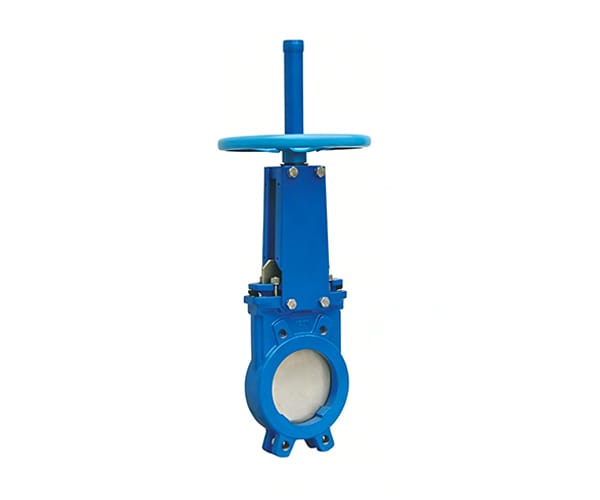
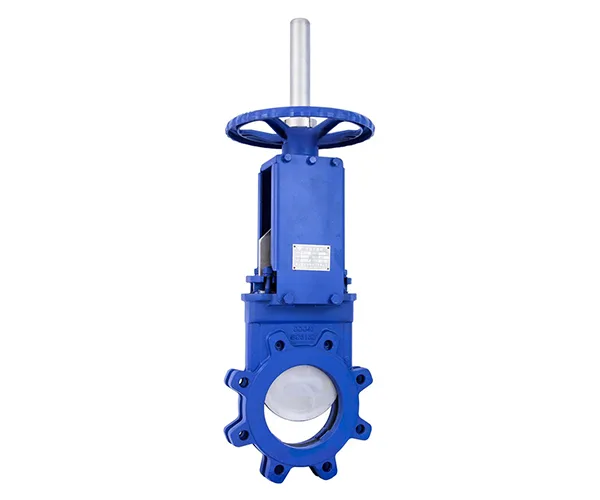
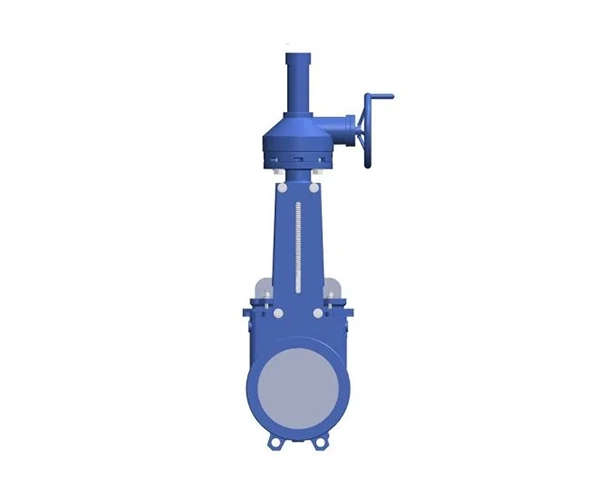
Two-way knife gate valve
The Two-Way Knife Gate Valve is specifically designed for isolation and flow control in systems that handle slurry, viscous liquids, and other media containing solids. It features a robust knife gate that cuts through thick and abrasive materials, ensuring smooth operation even in harsh and challenging environments. This valve is most commonly used in industries such as mining, wastewater treatment, pulp and paper, and chemical processing. Its design allows for bidirectional flow, providing greater versatility in installation and operation.
Category:Absperrschieber
Call Us Anytime
15669818867
Product Overview
The Two‑way Knife Gate Valve is a gate valve with a sharp knife‑edge disc that can withstand media pressure from both directions and provide reliable shut‑off. Unlike unidirectional knife gate valves, the two‑way knife gate valve features a specially designed sealing pair (typically a bidirectional floating seat or double‑sided sealing construction), ensuring zero‑leakage closure regardless of the flow direction.
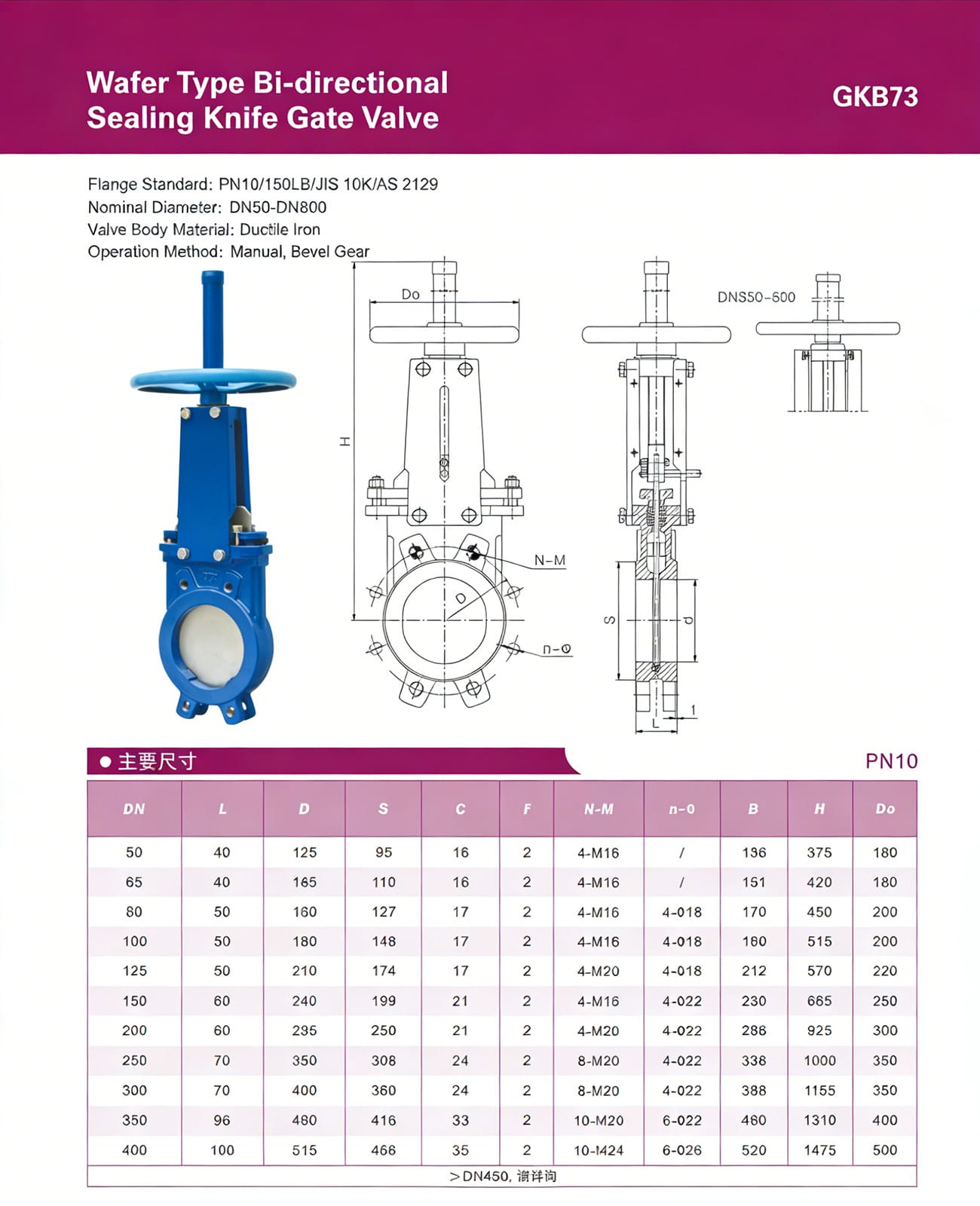
This valve is suitable for harsh media containing solid particles, fibers, and slurries, and is widely used in papermaking, wastewater treatment, mining, chemical, and power generation industries. The sharp knife‑edge disc can cut through hanging fibers and solids during closure, providing self‑cleaning action and preventing clogging. The valve has flanged connections, with nominal diameters from DN50 to DN1200, pressure ratings PN10/PN16 (Class 150), and body materials including cast iron, carbon steel, and stainless steel.
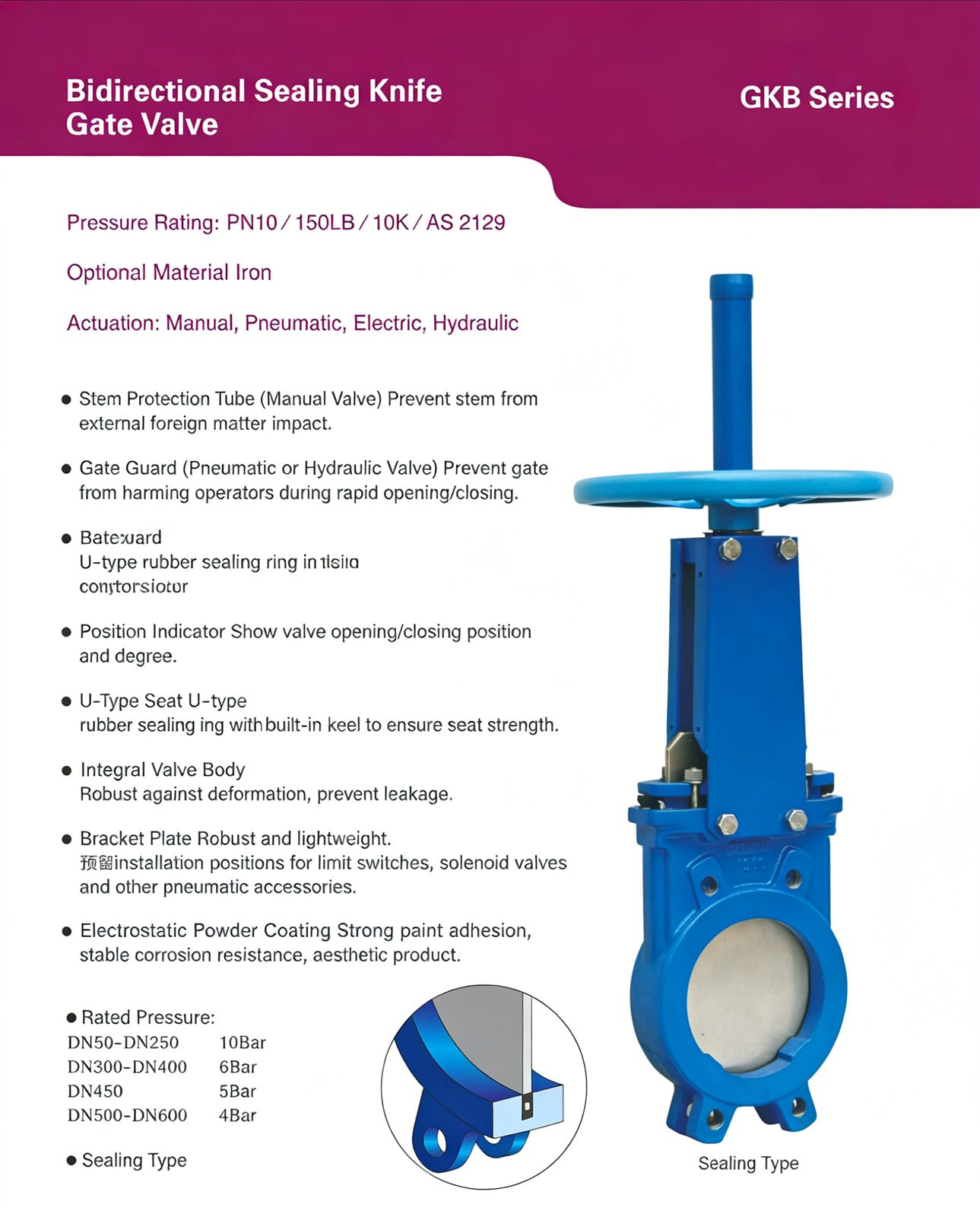
Produktstruktur
The Two‑way Knife Gate Valve mainly consists of the following parts:
-
Gehäuse: Cast or fabricated body in gray cast iron, ductile iron, carbon steel (WCB), stainless steel (CF8/CF8M), etc. Flanged ends conforming to GB/T 9113, ANSI B16.5, EN 1092‑1, etc. Full‑bore flow path with no pockets to prevent material buildup.
-
Schieber: Stainless steel (304, 316, 310S) knife‑edge gate with a sharp edge to cut through fibers and particles. The gate surface can be hardfaced with Stellite or chrome‑plated for improved wear resistance.
-
Dichtungen: Bidirectional sealing seats – typically a floating seat or double‑sided sealing design. Seat materials include rubber (EPDM, NBR, FKM), PTFE, metal (Stellite hardfaced), or ceramic. The bidirectional design ensures pressure‑tight sealing from either direction.
-
Spindel: Stainless steel trapezoidal‑thread stem, connected to the actuator at the top and the gate at the bottom, lifting and lowering the gate.
-
Bonnet: Integral or separate bonnet with internal guides to ensure vertical gate movement.
-
Stopfbuchse: Contains PTFE or flexible graphite packing, compressed by a packing gland to prevent external leakage. Blow‑out proof construction optional.
-
Joch: Supports the actuator.
-
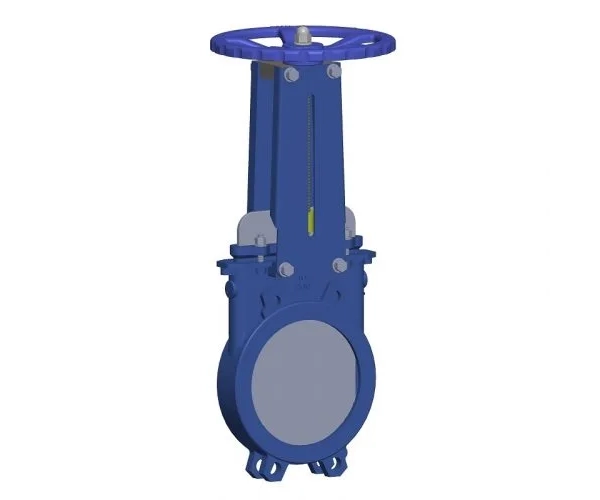
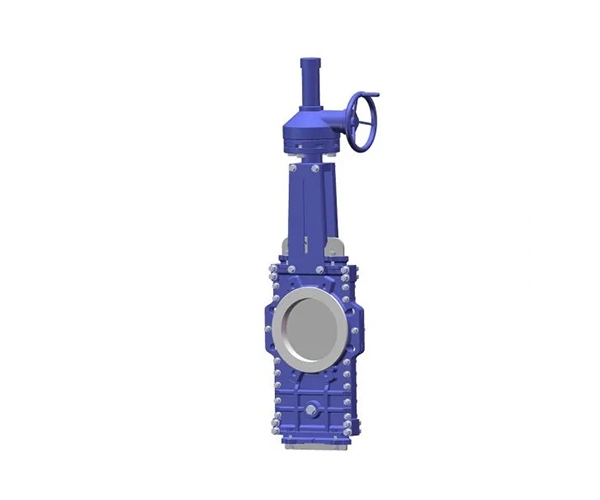
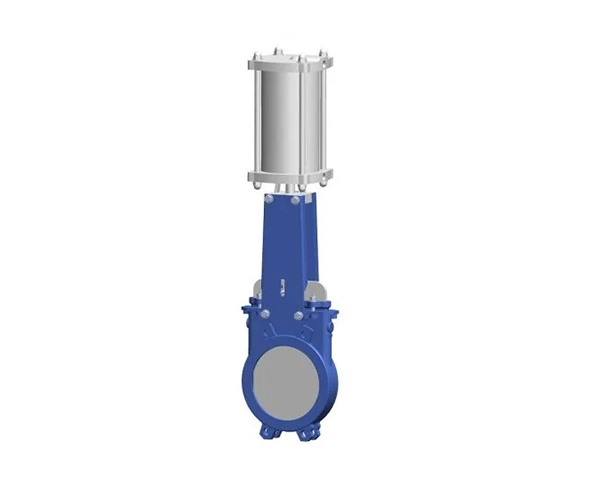
Actuator: Available with handwheel (manual), bevel gear, electric, pneumatic, or hydraulic actuator.
Simple construction, dead‑spot‑free flow path, vertical gate movement, and reliable bidirectional sealing.
Funktion
-
Bidirectional Media Shut‑Off: Regardless of which side the media enters, the floating seat is pressed against the gate by media pressure, achieving bidirectional sealing with zero leakage.
-
Schneidfunktion mit scharfer Kante: The sharp edge of the gate cuts through hanging fibers, paper, plastic strips, rags, and other materials during closure, preventing clogging.
-
Selbstreinigender Strömungsweg: Der Strömungsweg im Gehäuse weist keine Hinterschneidungen auf. Bei voller Öffnung kann das Medium das Innere spülen und so die Ansammlung von Feststoffen verhindern.
-
Wear and Corrosion Resistance: Optional hardfaced gate, ceramic seat, or all‑stainless‑steel construction for abrasive or corrosive media.
-
Vollerdurchgang mit geringem Strömungswiderstand: Bei voller Öffnung befindet sich der Schieber vollständig außerhalb des Strömungswegs, was einen minimalen Druckverlust gewährleistet.
-
Multiple Actuator Options: Manual, electric, or pneumatic operation to meet different requirements.
-
In‑Line Maintenance: Some designs allow packing and seat replacement without removing the valve from the pipeline.
Arbeitsbedingungen
-
Anwendbare Medien: Pulp, sewage, sludge, mineral slurry, coal slurry, powders, fiber suspensions, particle‑laden liquids, corrosive liquids, etc.
-
Temperaturbereich: –20 °C bis +200 °C (PTFE-Dichtungen); –20 °C bis +80 °C (Gummidichtungen); –29 °C bis +550 °C (Metalldichtungen).
-
Druckstufe: PN10, PN16 (Class 150); höhere Druckstufen auf Anfrage.
-
Nenndurchmesser: DN50 – DN1200 (2″ – 48″); larger sizes available on request.
-
Installation Orientation: No strict direction limitation (bidirectional sealing), but vertical stem‑up installation is recommended.
-
Typische Anwendungen:
-
Pulp line shut‑off in paper mills
-
Sewage and sludge lines in wastewater treatment plants
-
Mine tailings transport pipelines
-
Ash and slag lines in coal‑fired power plants
-
Chemical fiber and polymer slurry pipelines
-
Fruit pulp and sauce pipelines in food industry
-
Dust collection ash lines in steel mills
-
Zusammenfassung
The Two‑way Knife Gate Valve, with its advantages of bidirectional sealing capability, knife‑edge cutting function, self‑cleaning flow path, and wear/corrosion resistance, is one of the most reliable shut‑off valves for applications involving particles, fibers, and slurries in papermaking, wastewater, mining, and chemical industries. Compared with unidirectional knife gate valves, the two‑way version requires no consideration of installation direction and can accommodate changing flow directions or bidirectional pressure requirements.
Compared with ordinary gate valves, the knife‑edge gate effectively cuts through fibers and particles, preventing clogging. The valve features flanged connections, a full‑bore flow path, and fast open/close operation. For pipeline systems that handle media containing solid particles, fibers, or slurries and require reliable bidirectional shut‑off, the Two‑way Knife Gate Valve is an ideal choice.

 English
  German
  Chinese
  Dutch
Dutch  Vietnamese
  Uzbek
Uzbek  Turkish
  Thai
Thai  Norwegian
  Russian
  French
  Korean
  Persian
  Spanish
  Ukrainian
  Serbian